Thursday, December 31, 2009

Snot Like Cm Before Ovulation

Ash


New altarpiece of the Virgin of Guadalupe

http://www.pulsoslp.com.mx/NotasHistoricas.aspx?Fecha=20091215&Nota=728
Santa
Hugo Renteria María Acapulco / Pulse

After the tragic fire that consumed almost the entire Temple Assumption of Santa Maria Acapulco for more than two years, restoration work and play continues with the difficult challenge of recovering one of the most important ceremonial centers for ethnic Pame.

The Pames are an indigenous group has its largest core in the municipality of Santa Catarina, San Luis Potosi, since Queretaro Pames have completely disappeared.
gradually takes shape this architectural stamp of the Franciscan missions of Sierra Gorda, dating from the eighteenth century, was made with masonry and has already recovered its thatched roof, with the traditional technique of tissue Pame.

murals have been restored and part of the facade, although the work will be completed in its entirety until 2012.

For his features entirely indigenous production techniques, this temple is just as important as that of San Juan Chamula in Chiapas. Have documentation to the National Institute of Anthropology and History as "Historic Monuments, as it was one of the main centers of evangelization Pame when the English conquered.

The first altar was successfully reproduced the Virgin of Guadalupe, an image of great symbolic and cultural value to the indigenous group.

expert restorer For Renata Schneider Glantz, National Coordination of Cultural Heritage Conservation CNCA-INAH, "was very important that the first altarpiece reproduce outside it, the Virgin of Guadalupe is central to their religious ceremonies."
For INAH expert restorer, this reproduction is not given a finished "grandfathered" for the public to appreciate that is a copy of the original, but the elements are presented such as what were in the previous tableau, restoration expert says, with the assistance of many people of ethnicity.

The altarpiece

To make the assemblies used wood altarpiece as "oak" or "red cedar", the details are made with silver leaf, to make the "vermeil" to the expert restorer Renata Schneider: "the only thing put was a patina not shine so much money. " In the sculptures have been used gold leaf, for which they are golden, like wood and reproduced the fingers or hands were needed for each image.
This "Guadalupana Pamela" is a painting of exceptional beauty, the Virgin is flanked by four images that emulate the appearance that made the Indian Juan Diego.

And on top of the altarpiece, a painting of St. Francis of Assisi kneeling before the appearance of Jesus, he extended his arms with wings, a mixture with the holy spirit. Around the altar we can see the mural, with the hallmark of Indian hands.
can not put other decorative elements to the original, since it would be fake, for next year work will continue altarpieces of "The Seven Sorrows" and "San Jose". To date have invested three million dollars in those studies. The event was attended by director Miguel Angel Riva Palacio of San Luis Potosi INAH delegation, and Amalia Velasquez de Leon Collins Director of Conservation and Restoration of federal INAH.

Japanese Forbidden To Eat Meat

NAMASTÉ, it's 2010 ...

The days and nights happen each other without interruption, and while some are laid off and others come ... the seconds of life seems to stop .... and although nobody knows for sure when or how this started ... (Well what the bigbang, and the big bands!, And even the music of the spheres ...), if there are early or late and if we see that phenomena are only different stages of change, days like today , 31 December, we try to put a point and followed the incomprehensible magnitude of the time, they are nevertheless, in my view, valuable.
A small break in the way of the senses, the ability to dive inside ourselves and see what happened to us now. Roads, challenges, games, effort, courage, mistakes, learning, the loves that are and are not, what we are and finally ... know that beyond all that, we remain, thanks to the mysterious life and color that still flows in us.
So ... Will arrive in 2009 and 2010!, hardly a trace of brand, is like Armstrong in the infinite space? ... and I think even better is above all a tribute to time, bringer of eternal life. Life and Time, are lovers? ... Then today I welcome also his eternal romance !....

with you welcome this parade poetic and transcendental between inhalation and exhalation, life and death in which we took as actors and witnesses, courageous and adventurous, filling together the ways of a script with an ending that makes known the plot, let us seek to understand sooner or later, choosing to do wires that we can grasp with greater certainty. The threads of the conversations we have had lit, those in the art, science, the kitchen, the mate, the hug, the sport, the maternity and paternity leave, the dance, those religions, of languages, the signs, the meditation, the practice carefully ... Who are we to engage in life! that we fall in love with its mystery .... Welcome to have a 2010 where we meet, embrace, seek and understand ever more deeply, love without restrictions this miracle, this gift and mystery. For more good, than evil, action and reflection, and return trips, search and findings, detachment and commitment, understanding and love
Bethlehem.
Namaste!


has multiple meanings Namasté is a Hindi word comes from Sanskrit. I learned it briefly as "revere your divine essence is the divine essence in me." But in wikipedia and many other definitions found this to share with you today and always,

"I honor that place in you where the entire universe dwells, I honor that place in you that is a place of love, truth , light. And I know when you are in that place within you, and I am in that place within me, you and I are one .

Namaste! ...

Ile.

Sunday, December 27, 2009

Gold Refiner, Houston


tubular bells are a percussion instrument, usually consisting of eighteen pipes, that can be aluminum, steel, copper or brass, suspended vertically in a frame. These pipes are casings with one or two decks, always on top. Each "bell" (ie, each tube) is about 30-38 mm. in diameter and have a different length, thus offering different notes. This instrument also has a pedal or a bar to stop the sound. Extension (Helmholtz) goes from middle C (C1) of the piano to the next octave fa (F2).


Name of "tubular bells" refers to their sound is similar to that of large church bells. In fact, his invention was held primarily to avoid the inconvenience of moving large and impractical original bells to the orchestra.

tubular bells were first used during the nineteenth century century, when the opera was needed the sound of church bells. The Tchaikovsky's 1812 Overture was one of the most famous works in which they were used, just at the climax, they represent the church bells proclaiming which has won the war against France. Mike Oldfield would make famous in the twentieth century with its Tubular Bells 1973, a concept album of instrumental rock English, remembered for the opening track on the plate that was used in the movie The Exorcist . The production of this instrument grew, especially thanks to the demand generated by collectors and other artists, which included the invention in many subsequent creations.


Tubular Bells a telemin


Tubular Bells other percussion instruments


Tubular Project playing the theme from "The exosrcista" Mike Olfield


part orchestral


Bells

Saturday, December 26, 2009

Nadine Jensen In A Girdle

Didjeridoo Tubular Bells (also Yidaki)


The didjeidoo is a wind instrument used by Australian Aborigines. This instrument is basically wood or pipe is sounded by vibrating the lips at one end. This vibration is amplified by the tube walls, creating a unique sound and deep. It is possible to modulate the vibration obtained by moving the lips and tongue, or adding to the vibration arising from the throat sounds. In addition, the sounds produced are remarkable rhythmic imprint, often sounding almost like a percussive instrument.


didgeridoo The term does not derive from native language, but is the name given by Europeans in their first visits to the island. In different aboriginal languages \u200b\u200bused different words to describe this instrument, among which we note yidaki , ginjungarg , ebor , djalupu , Maluk , etc. The name most commonly used by the Aborigines is the first one mentioned, yidaki , which means "Instrument of spiritual connection."


Originally, the didgeridoo was created from dead trunks of trees, mostly eucalyptus, whose interior was eaten by termites. When cleaning the trunk, you get a long tube which is thus the instrument. A didgeridoo usually measured between 6 and 12 inches in diameter, and its length can vary from about 50 centimeters to two meters or more. The length of the instrument determine the seriousness of his tone, that is, the longer it sounds more serious . Some show a widening in the lower mouth, similar to a trumpet. Often the upper mouth, by which it blows, features a cover of beeswax as a mouthpiece to prevent irritation of the lips due to friction. A particular feature is that you can play for an unlimited time using a technique called circular breathing, which is continuously maintain a certain air pressure in the mouth, inhaling air through the nostrils.


The fundamental tone is composed of a variety of simultaneous sounds like harmonics and vocals. Their sound is visceral and vibration can be expanded with a low frequency can generate a strong effect on the nervous system. Already in ancient times northern Aboriginal elders shakes made use of the properties of digeridoo, as a cultural symbol and identification of their origin, in different contexts to ritualize the foundations of their existence. It has been used since ancient times as a ritual object and theatrical mimesis with the environment, as an accompaniment to the voice as well as a solo instrument. Within the Aboriginal clans, and still today, shows distinction in rank or caste of the capabilities of the musician who plays it. Generation after generation passed its own system is being played by clans whose provenance has its origins the didgeridoo, in northeastern Arnhem Land (Northern Territory, Australia). They refer to physically sound, from father to son, from master to student, so to transmit the knowledge in the complex techniques used to play it.


Legends

According to the Australian Aboriginal peoples, in the beginning was the sacred. In the beginning was the Dreamtime, the time Tjukurpa. At that time, existed on earth only a still life, a substance embryonic huge, translucent, consisting of a mixture of unrealized beings, belonging to a plant or animal species. And so that "he who came from nowhere and exists by itself" the so-called Supreme Being, who carved in that shapeless body, arms, hands, legs and head. Thus created beings capable of stand. During the Tjukurpa was created everything: mountains, valleys, plains, stream. There was nothing before Tjukurpa. During the Dreamtime, ancestral beings in the form of humans, animals and plants traveled the length and breadth of the land and consummated essential facts of creation and destruction. Travel of those beings are still remembered and celebrated the sacred memory of those journeys still lingers in the form of geographic features, such as the sacred mountain of Uluru.


In that era the Dreamtime the Supreme Being, the Great Sacred Energy, released its essence, its power, in each of humans, in each of animals, plants and minerals, the stars and in the air and water. Then the Great Ancestors giant creatures ended up creating the world as it is now. Thus, January linkages between different peoples, from north to south, from east to west, the relationships created a giant web spun yarns which guide and protect us since then.
Later, before disappearing, before the end of the Dreamtime, when men were born in its current form, they said, "This is your country. We have created for you. Here you will live and Conserving still as you we deliver. There never will leave you, for you are its Guardians. You are the guardians of our creation. " And then the Dreamtime, was born on didgeridoo.


The didgeridoo was created during a heartbeat inaccurate in the past. Two teenage girls were abducted by a giant who wanted to become their wives. After a long time, the girls escaped and returned to their tribe. The giant was hungry when he discovered what had happened. He then went to claim what he considered his property. Meanwhile, the older youth of the tribe, made a trap to catch the giant. They dug a big hole along the path leading to your home. The giant, in his hungry haste, fell into the pit and was killed immediately by the spears of the hunters close, remained hidden. Before his death, being Cyclops rolled on his penis. He looked like a porcupine when he began hitting his phallus and deliver an amazing and buzzing sound. The hunters of the tribe tried to imitate this sound. Only did it when they found a long hollow stick whose center had been eaten by termites. And after blowing a hollow end of the long pole found they could make a sound very close to that generated by the giant caught. Thus was born the first didgeridoo.


But perhaps one of the most widespread stories about the origin of ancient Australian instrument is one that ensures that, once, three men camped on a cold night in the desert. One of the passengers asked another that would put a log on the fire, he struck her several times and found a stick, hollow inside. Upon his return he discovered that the tree was crowded with termites in their entirety. The man did not want to throw the branch then the fire because then kill the termites. However, his friends told him to surrender to the flames in the bottom because it was cold and needed to generate heat. So removed all the termites, deposited in one of his hands and then stayed in the log. Then he raised his arm to his lips and breathed heavily. And the termites that were in the air became the stars. And so the first didgeridoo was created.


The didgeridoo is also associated with the mythical Rainbow Serpent, perhaps the world's oldest divinity. The reptile sacred of the seven colors played an important part in creating sliding on the ground, making rivers and outlining the most distinctive features of the landscape. In the ceremonies of the Gjun Guwan the didjeriddo with particular measure, about 2.5 feet high and represents Yurlunggur, Rainbow Serpent.
didjeriddo Another story linked to the creation and said that in the beginning, the Great Spirit Balam created man and woman, on whom fell the responsibility of creating the birds and land animals. Creation consummated by chanting and the sound while playing the didgeridoo.

Jeremy Donovan, Aboriginal artist


Mack Yidhaky


didjeridoo solo percussion


didgeridoo and percussion More


didgeridoos Duo


Ensamble Yidaki


electronically modified Didjeridoo


band improvisation with didjeridoo


Jazz fusion with didjeridoo

Saturday, December 19, 2009

Does Male Yeast Infection Cause Groin Pain


">

This video seeks to highlight the events of July 1, 2007 in the town of Santa María Acapulco , SLP when after a thunderstorm the church of Our Lady of the Assumption was devoured by fire.
Within hours the rich cultural heritage of the eighteenth century turned into ashes.
are the inhabitants themselves Santa Maria, indigenous xi'oi who tell us the tragic details of the incident.

Friday, December 18, 2009

Bacterias Resistant To Hydrogen Peroxide

Delivery Reports INAH the altarpiece of the Virgin of Guadalupe. Santa María Acapulco San Luis Potosi.

To see what was said at the news of Lopez Doriga:


http://www.tvolucion.com/noticieros/noticias-y-reportajes/052075/entrega-inah-reconstruccion-retablos -slp

San Diego Where To Buy Morton Tender Quick

From the restoration of the church of Our Lady of the Assumption. Pamela flute and flute

Delivery
altarpiece restoration INAH 250-year-old Jose Aguilar Noyola

16/12/2009


Experts
INAH delivered in the municipality of Santa Catarina, in SLP, the restoration of an altarpiece of the Virgin of Guadalupe 250 years old.

SAN LUIS POTOSI, Mexico, December 16, 2009.

The July 1, 2007, a fire almost ended the church of Santa María Acapulco, in the municipality of Santa Catarina, in the indigenous area of \u200b\u200bSan Luis Potosi Pame.

"... It is a temple with her until the fire because the community is very isolated and is a traditional indigenous community Pame," said Renata Schneider, INAH restorer.

The temple with a thatched roof and wooden, was built in 1740 with construction techniques of ethnic Pame.

"... They had the temple as it was with a series of sui generis uses in the country and do not exist anywhere else," said Schneider restorer.
Nearly two and a half of that fire caused by lightning, was given an altar and constructed the first altar of the Virgin of Guadalupe.

Experts from the National Institute of Anthropology and History conducted work to reconstruct the original features of altarpieces altars, paintings and murals that were damaged by fire. The Indian community received with joy the reconstructed altarpiece of the Virgin of Guadalupe.

The restoration of the altar and the altar dedicated to the Virgen Morena indigenous participation in the region, advised by INAH restorers.

The delivery of the works was celebrated with a Mass offered by Archbishop of Ciudad Valles, Balmori Film, Pame Indian community to the middle of San Luis Potosi.

Thursday, December 17, 2009

Manual 5th Wheel Dutchman

Tenek touched

Go to this link for more information: http://www.tlapitzalli.com/ehecatl92/pame/fpame.html

Sunday, August 30, 2009

Nadine Jansen In A Girdle

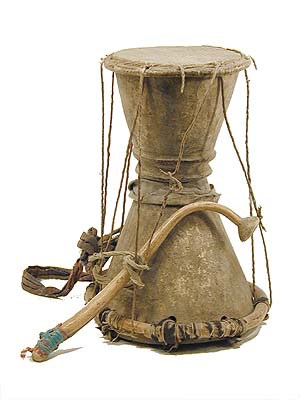
Talking Drum (or Tama)


The talking drum (literally in English "talking drum" or "talking drum"), or size, is a percussion instrument originating in Nigeria, and its name comes from its peculiar shape and ability to pitch allow a variety of sounds, to the point where it is said the drum "talks" and can even transmit accurate messages This instrument is shaped like an hourglass, with a patch on each end (which may be of goatskin , lizard or fish skin), and a belt around his body going from one patch to another and serve to refine it. The player puts the drum just below your armpit and hit one of your patches one a stick special curved at one end. When the performer presses his arm tensioners drum against his body, while they hit, the pitch varies and can be heard as this instrument effectively "talk." This ability to change the "tone" of the drum is similar to the shades of the languages \u200b\u200bspoken in Nigeria.


The talking drums are one of the oldest percussion instruments of the griot (also known as jeli, are tellers of stories, poems rhapsodies and tribal) of West Africa and its history can be traced to the ancient Empire of Ghana. The Hausa people (and influence, the Yoruba of southwestern Nigeria and Benin and the Dagomba of northern Ghana) have developed a highly sophisticated style of music centered griot talking drum. There talking drums of varying sizes depending on the region within the contemporary West Africa, with the exception of North West Cameroon and Chad.
The different sizes of these instruments, also correspond to ethnic diversity. For example, the size of the Wolof and Mandinka villages are characterized by is smaller than this have a higher pitch and produce sounds acute. The Yoruba peoples and Dagomba, on the contrary, are larger and more serious sound. In assemblies Yoruba talking drums, these are played with a similar but smaller drum, called gangang in your language.


The different styles of playing these drums, are linked to the tonal qualities of each language. There is a clear difference in style between speaking areas predominantly Fulani and Mande, and traditionally do not send more to the east. The predominant style of playing areas further west, such as Senegal, Gambia, Western Mali and Guinea, is characterized by fast and explosive fills, which probably relates to the different non-tonal languages \u200b\u200bof the region. This style can be heard well in the popular genre of Senegal called Mbalax. From Mali, Burkina Faso and Ghana to Niger, western Chad and Nigeria (excluding Fulani-speaking places and send), the style of the talking drum HRCT is focused on producing long sustained sounds, with a texture resembling complex and heavy tones of the languages \u200b\u200bof the region. This style can be heard in popular music of the region, where the talking drum is usually the main instrument, as in the Fuji music of the Yoruba of Nigeria.

Ayan Bisi Adeleke playing a talking drum


Yoruba Talking Drum


Michael Lipsey plays "Mr. Trampoline Man" with talking drum and table


Bambay - Talking Drum session


Marcelo Garcia Improvisation and Talking Drum Garrahand


Playing the talking drum

Thursday, August 27, 2009

The Inside Of A Vergina

The quijongo ( or carimbó)


quijongo The stringed instrument is a percussive, used by natives of Nicaragua and Costa Rica, and known under the name of carimbó by Indians El Salvador. It consists of a flexible wooden stick, spread in an arc by a hemp rope, or metal and has held in place or a third of the way a small gourd (a small bowl made from the fruit of the gourd or Pumpkin, used for drinking water) that serves as a sounding board, although it was sometimes reinforced quijongo support base in another box.


This instrument is about 140 centimeters long and strike the string seejecuta by well seasoned with a stick to uncover and alternate cover the mouth of the cup with fingers hand, there was a sound like the wind swung to whistle through the woods, ranging in fourth and sixth pitch.

quijongo Duo (modern) and banjo (I could not encuntra quijongo true, but it's close)

Wednesday, August 26, 2009

Nursing Diagnosis Celllitis

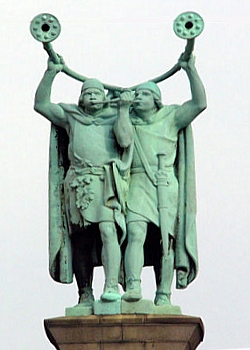
Lur (also Luur or Lure)


The lur is a wind instrument traditional Scandinavia, whose appearance is of a type of trumpet without finger holes. It is played out through the nozzle, much like a horn or a trumpet, located one end. With this name, or also known as Luur or lure are called actually two different instruments, although very similar, a more recent, made entirely of wood and used in Scandinavia during the Middle Ages, and the older one, made of bronze, dating precisely from the Bronze Age, found often in pairs in swamps, mainly from Denmark. After archaeological efforts, have found a 56-toral lurs: 35 in Denmark (excerpts), 4 in Norway, 11 in Sweden, 5 in northern Germany and 1 in Latvia.

is quite likely that the lur was a tool to be used in processions, celebrations, social events, religious ceremonies, etc. With its elegant curve, the lur was around the back of the performer, and was with his companions, a colorful scene. Such a scene is represented, in action, in the rock engravings of Kalleby (Bohuslän, Sweden). Lurer
The Scandinavian and the horns of Ireland has not escaped the symbolic interpretation. Inevitably, its form coincides with that of the horns of a bull. Its role, hypothetically, has been associated with rituals of exaltation of the bull. Although the hypothesis can not be proved, is in the air the question of whether the art of metallurgy, applied to music, was also, at the time that deal of religious art.


The first references to an instrument called lur come from the Icelandic sagas, which describes it as an instrument of war, used to rally the troops and frighten the enemy. These lurs were straight, with a wooden pipe and about a meter long. They had no finger holes and is played as an instrument of modern metal.


lur A species very similar to these instruments of war have been used by farmers and ranchers in the Nordic countries as least since the Middle Ages. These instruments were used to call Algana and guidance. Its construction technique is similar to touching an instrument of war, but were covered with birch, while the instruments of war were covered with sauce.
is likely that the bronze instrument now known as lur unrelated to the wooden lur was made that way by the Archeological nineteenth century after century wooden lurs mentioned XIII by Saxo Grammaticus.


The bronze lurs back to the Bronze Age Norse probably in the first half of the first millennium BC. A broadly conical tubes are S-shaped, without finger holes. At the end of the tube has a bell, like the brass instruments, and sound more like a trombone. The opposite end of the hood has a slightly flared just as the modern bronze bell, but not to the same extent. A typical bronze lur measuring approximately two meters long.


wood Lur


Lur bronze

Monday, August 24, 2009

Best Gold Refinery In Houston

Balalaika (or balalaika)


The balalaika (Russian: балалa ' йка) is a stringed instrument of Russian origin and is associated eneral the lute family. Its case is triangular, almost flat, with a small hole resonance in the upper corner of the lid. Attached to the box, is a long narrow neck, and has three strings that can be metallic or animal gut. The strings are usually pressed with your fingers and sometimes you can use a plectrum of skin to touch the metal strings. Formerly, the dishes were mobile, like other instruments such as the tambura or saz, and were made from animal gut.
can distinguish six kinds of sizes (piccolo, prima, second alto, bass and bass, respectively, from lowest to highest), and seems to have originated around the eighteenth century from the domra or dombra of Central Asia Siberia, much like the balalaika. Two of the balalaika strings are tuned in unison and the third to a quarter distance, such as the balalaika more importantly, the soprano or premium, is refined in MI4, MI4 and LA4. Historically
play the balalaika in Russia has been banned on several occasions, because, first, to their use by skomorokhi (clowns), which were highly irritating to the Church and State, and, secondly, to instruments music not allowed in Russian Orthodox liturgy.


Interestingly, a popular belief is that the three sides and strings of the balalaika represent the Holy Trinity. However, according to the writer and historian Nikolai Gogol, in his unfinished novel "Dead Souls", says a more likely reason for the triangular shape of the balalaika is that it was created by peasants from a gourd, which adopts the cracking peculiar form of this instrument. Another explanation may be related to the fact that prior to Czar Peter the Great, the instruments were not allowed in Russia, and when Peter finally allowed them, only the boat builders knew how to work with wood. Hence it is often claimed that the shape of the balalaika partly resembles the prow of a boat, if held horizontally.
late nineteenth century, a Russian nobleman, Vassily Andreyev Vassilievich, undertook a project to standardize the balalaika for use in the orchestra. Andreyev, and Nalimov furniture manufacturer, developed the multiple balalaika sizes that exist today. This noble adapted many songs and popular melodies Traditional Russian orchestra and also composed many works themselves. Aleksei

playing the balalaika Arkhipovsky


guitar and balalaika duo


Russian Folklore balalaikas


Russian Folklore and domras balalaikas


Sunday, August 23, 2009

Covering Letter Clothes Store

Kolibit (or bamboo zither)


The kolibit is simply a small bamboo tube with a series of ropes that go from one extreme to another, with a kind of nut on each end to raise the strings and thus produce sound when touched. The kolibit is a particular instrument from the Philippines, Kalinga culture, but you can find instruments of this kind in Southeast Asia, especially Indonesia, and even in Oceania. These instruments typically have an average of ten or eleven strings, which are pressed to provide sound. Generally, you identify this type of instrument dento the xylophone family (understood as a generic name in musicology).

The following can see a single link of the Philippines kolibit:

rtsp: / / media.nacs.uci.edu: 554/rgarfias/avi/kalinga-kolibit.rm

This is not exactly a filipino kolibit but is of the same family of instruments:


Saturday, August 22, 2009

Nbad Fixed Deposit Rate

Minuet for Day of the Dead 15/11/2008

http://rapidshare.com/files/270409742 / Minuete_Santa_Mar_a_Acapulco.mp3

Fluffy Blueberry Scones

Khuur


The Morin Khuur (Mongolian: морин хуур) is a bowed string instrument originating in Mongolia . It is a sort of horse-head fiddle, with two horsehair strings and is played similarly to a cello . In Chinese it is known as matouqin ( 马头琴) . Their sound is poetically described as expansive and free, like a wild horse neighing, or like a breeze on the grass. It is without doubt the most important instrument of the Mongolian people, and therefore is considered a symbol of the Mongolian nation .
The instrument consists of a trapezoidal sounding board of wood attached to a mast and two strings, made with horse tail hair, running parallel to the two tuners located on the horse's head from the top of the fingerboard. It runs in an almost vertical position, resting the box on lap or between the legs of the musician. Similar to a violin or a cello , the strings are rubbed with a bow, which is covered with bristle resin, which is supported by the right hand. The sow the arch hand squeezes, which allows very fine control of the timbre of the instrument.


Rope more thick, the "male", is composed of 130 hairs from the tail a stallion, while the thinnest string, or "female", consists of 105 hairs from the tail of a horse. The tuning of the strings was traditionally a fifth, but today often are tuned a quarter distance.
Previously, she covered the box with leather camel, goat or sheep, leaving a hole, but since the 1970's, are usually made entirely of wood with caladuras as "f" characteristic of European bowed string instruments .


The shape of Morin Khuur varies by region. Those in the central Mongolia usually have larger bodies and a larger volume than the smallest interior Mongolia. Playing

Khuur Morin


Music with Khuur Murin


Khuur Morin and orchestra - "galloping horse"


Friday, August 21, 2009

Brent Everett And Brent Corrigan Ddl

mizmar Morin (also Zurna or Zourna)


The mizmar, also called zurna, zourna , zukra, zamr or surnay between otos names, is a wind instrument double-reed and therefore can be considered as an "ancestor" of the oboe. There is evidence that such instruments existed in Palestine in the second century AD Today, we can find throughout the Arab world, with its variants, as well as in Turkey, Armenia, Niger, Greece (where it is known as pipiza or karamouza ) and to the Balkans.


This instrument has a very particular sound, sharp and strident, and normally used circular breathing to run. In some places, usually run in pairs: while one mizmar plays a melody, the other holding a same tone without changing. In Egypt, it is widely used in the folk dance of
Saidi. In the Ottoman Empire, was primarily used in military music of the Janissaries (in mehter , or military band), due to its considerable loudness and stridency, usually accompanied by drums. In modern Turkey, is very common to hear this instrument at weddings accompanied by tabl (a kind of double-bass patch, widely used in folk music). Playing

mizmar


Music with mizmar


Taksim (improvisation) of a mehter zurna (Ottoman military band)


Ottoman military music with zurna


Wednesday, August 12, 2009

Gall Bladder Attack Following The Flu

Music & instruments

http://folkloreyetnohistoria.blogspot.com/2009/12/descargar-musica-bizantina-e-de-mexico.html

http://macuala.blogspot.com / 2009/08/vientos-sagrados-musica-ceremonial-pame.html

Winds sacred, ceremonial music pame
Rufino Medina and Juan Medina

CNCA-DGCP-Regional Unit of Popular Cultures of Querétaro, INAH
Cultural Institute of San Luis Potosí 1998


recording and text : Félix Rodríguez León and Marina Alonso.

This phonogram shows a part of ceremonial music universe of two towns of San Luis Potosi Pame: Santa María Acapulco and San Diego for whom this artistic expression fulfills the function determined by its philosophy, its commitment with the land, with man, nature, is an individual or social event, interpreted language that accompanies pame aspects of community life that distinguishes them as an ethnic group.


Side A
1. Son of butterflies (mitote)
2. Son of the fox (mitote)
3. Son of the Flies (mitote)
4. April Flower (minuet)
5. A star (minuet)
6. Three candles (minuet)


[ftacho.jpg]
Flute Don Anastasio "Tacho" Rubio de Santa María Acapulco

Side B
1. Dance during such ceremonies' uus (they dance)
2. Praise
3. They are the first step (mitote)
4. Son La rod (mitote)
5.
praise procession
6. Son of the Viper (mitote)


[flauta_pame_3+Don+Rufino+Medina.jpg]


Flute pame of Santa Maria Acapulco, San Luis Potosi.
Don Rufino Medina donated by Dr. Carlos Garcia.


Historically, the territory of indigenous groups in Mexico has been changing boundaries, boundaries that due to various factors, stretch and expand, so for example, pame region has been fragmented by dividing line between the states of Querétaro and San Luis Potosi. However, these margins have been overwhelmed by the cultural dynamics.

For Pame, the musical expression is a form of communication with nature, with their ancestors, with their worldview. The sounds pame hear the flute, played by musician Medina Rufino, Santa María Acapulco and John Medina, of San Diego, both the State of San Luis Potosi, allow us to transport them to a culture and way of being different. The music they perform are sounds of mitote, representing the community rituals for the gods and the dead air.

To download the music file

http://www.4shared.com/file/157008459/88cf486b/disco7.html
http://rapidshare.com/files / 264933502/VS-MCPame.rar

This information is published in the following blogs:

http://folkloreyetnohistoria.blogspot.com/2009/12/descargar-musica-bizantina-e-de-mexico.html

http://
macuala.blogspot.com

If you want to learn more about traditional Mexican music, visit the pages above.

For the color cover of phonogram
http://qqhoka.blu.livefilestore.com/y1pquWnCDtX1ogDF3cuCxeaKKFSexJ5kMCWZWXBcqwfxnLkLMVIzT51Oydd_-AvGeEqHeKzDUCIO_sKbHL1KMRT312Xb5M-zrwQ/vientos-sagrados.jpg