
The Morin Khuur (Mongolian: морин хуур) is a bowed string instrument originating in Mongolia . It is a sort of horse-head fiddle, with two horsehair strings and is played similarly to a cello . In Chinese it is known as matouqin ( 马头琴) . Their sound is poetically described as expansive and free, like a wild horse neighing, or like a breeze on the grass. It is without doubt the most important instrument of the Mongolian people, and therefore is considered a symbol of the Mongolian nation .
The instrument consists of a trapezoidal sounding board of wood attached to a mast and two strings, made with horse tail hair, running parallel to the two tuners located on the horse's head from the top of the fingerboard. It runs in an almost vertical position, resting the box on lap or between the legs of the musician. Similar to a violin or a cello , the strings are rubbed with a bow, which is covered with bristle resin, which is supported by the right hand. The sow the arch hand squeezes, which allows very fine control of the timbre of the instrument.

Rope more thick, the "male", is composed of 130 hairs from the tail a stallion, while the thinnest string, or "female", consists of 105 hairs from the tail of a horse. The tuning of the strings was traditionally a fifth, but today often are tuned a quarter distance.
Previously, she covered the box with leather camel, goat or sheep, leaving a hole, but since the 1970's, are usually made entirely of wood with caladuras as "f" characteristic of European bowed string instruments .

The shape of Morin Khuur varies by region. Those in the central Mongolia usually have larger bodies and a larger volume than the smallest interior Mongolia. Playing
Khuur Morin
Music with Khuur Murin
Khuur Morin and orchestra - "galloping horse"
The instrument consists of a trapezoidal sounding board of wood attached to a mast and two strings, made with horse tail hair, running parallel to the two tuners located on the horse's head from the top of the fingerboard. It runs in an almost vertical position, resting the box on lap or between the legs of the musician. Similar to a violin or a cello , the strings are rubbed with a bow, which is covered with bristle resin, which is supported by the right hand. The sow the arch hand squeezes, which allows very fine control of the timbre of the instrument.

Rope more thick, the "male", is composed of 130 hairs from the tail a stallion, while the thinnest string, or "female", consists of 105 hairs from the tail of a horse. The tuning of the strings was traditionally a fifth, but today often are tuned a quarter distance.
Previously, she covered the box with leather camel, goat or sheep, leaving a hole, but since the 1970's, are usually made entirely of wood with caladuras as "f" characteristic of European bowed string instruments .
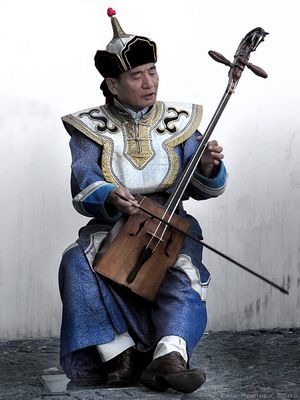
The shape of Morin Khuur varies by region. Those in the central Mongolia usually have larger bodies and a larger volume than the smallest interior Mongolia. Playing
Khuur Morin
Music with Khuur Murin
Khuur Morin and orchestra - "galloping horse"


0 comments:
Post a Comment