Sunday, August 30, 2009

Nadine Jansen In A Girdle

Talking Drum (or Tama)


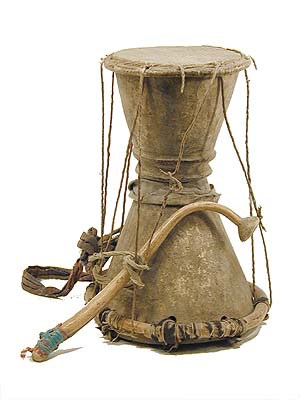
The talking drum (literally in English "talking drum" or "talking drum"), or size, is a percussion instrument originating in Nigeria, and its name comes from its peculiar shape and ability to pitch allow a variety of sounds, to the point where it is said the drum "talks" and can even transmit accurate messages This instrument is shaped like an hourglass, with a patch on each end (which may be of goatskin , lizard or fish skin), and a belt around his body going from one patch to another and serve to refine it. The player puts the drum just below your armpit and hit one of your patches one a stick special curved at one end. When the performer presses his arm tensioners drum against his body, while they hit, the pitch varies and can be heard as this instrument effectively "talk." This ability to change the "tone" of the drum is similar to the shades of the languages \u200b\u200bspoken in Nigeria.


The talking drums are one of the oldest percussion instruments of the griot (also known as jeli, are tellers of stories, poems rhapsodies and tribal) of West Africa and its history can be traced to the ancient Empire of Ghana. The Hausa people (and influence, the Yoruba of southwestern Nigeria and Benin and the Dagomba of northern Ghana) have developed a highly sophisticated style of music centered griot talking drum. There talking drums of varying sizes depending on the region within the contemporary West Africa, with the exception of North West Cameroon and Chad.
The different sizes of these instruments, also correspond to ethnic diversity. For example, the size of the Wolof and Mandinka villages are characterized by is smaller than this have a higher pitch and produce sounds acute. The Yoruba peoples and Dagomba, on the contrary, are larger and more serious sound. In assemblies Yoruba talking drums, these are played with a similar but smaller drum, called gangang in your language.

The different styles of playing these drums, are linked to the tonal qualities of each language. There is a clear difference in style between speaking areas predominantly Fulani and Mande, and traditionally do not send more to the east. The predominant style of playing areas further west, such as Senegal, Gambia, Western Mali and Guinea, is characterized by fast and explosive fills, which probably relates to the different non-tonal languages \u200b\u200bof the region. This style can be heard well in the popular genre of Senegal called Mbalax. From Mali, Burkina Faso and Ghana to Niger, western Chad and Nigeria (excluding Fulani-speaking places and send), the style of the talking drum HRCT is focused on producing long sustained sounds, with a texture resembling complex and heavy tones of the languages \u200b\u200bof the region. This style can be heard in popular music of the region, where the talking drum is usually the main instrument, as in the Fuji music of the Yoruba of Nigeria.

Ayan Bisi Adeleke playing a talking drum


Yoruba Talking Drum


Michael Lipsey plays "Mr. Trampoline Man" with talking drum and table


Bambay - Talking Drum session


Marcelo Garcia Improvisation and Talking Drum Garrahand


Playing the talking drum

Thursday, August 27, 2009

The Inside Of A Vergina

The quijongo ( or carimbó)


quijongo The stringed instrument is a percussive, used by natives of Nicaragua and Costa Rica, and known under the name of carimbó by Indians El Salvador. It consists of a flexible wooden stick, spread in an arc by a hemp rope, or metal and has held in place or a third of the way a small gourd (a small bowl made from the fruit of the gourd or Pumpkin, used for drinking water) that serves as a sounding board, although it was sometimes reinforced quijongo support base in another box.


This instrument is about 140 centimeters long and strike the string seejecuta by well seasoned with a stick to uncover and alternate cover the mouth of the cup with fingers hand, there was a sound like the wind swung to whistle through the woods, ranging in fourth and sixth pitch.

quijongo Duo (modern) and banjo (I could not encuntra quijongo true, but it's close)

Wednesday, August 26, 2009

Nursing Diagnosis Celllitis

Lur (also Luur or Lure)


The lur is a wind instrument traditional Scandinavia, whose appearance is of a type of trumpet without finger holes. It is played out through the nozzle, much like a horn or a trumpet, located one end. With this name, or also known as Luur or lure are called actually two different instruments, although very similar, a more recent, made entirely of wood and used in Scandinavia during the Middle Ages, and the older one, made of bronze, dating precisely from the Bronze Age, found often in pairs in swamps, mainly from Denmark. After archaeological efforts, have found a 56-toral lurs: 35 in Denmark (excerpts), 4 in Norway, 11 in Sweden, 5 in northern Germany and 1 in Latvia.

is quite likely that the lur was a tool to be used in processions, celebrations, social events, religious ceremonies, etc. With its elegant curve, the lur was around the back of the performer, and was with his companions, a colorful scene. Such a scene is represented, in action, in the rock engravings of Kalleby (Bohuslän, Sweden). Lurer
The Scandinavian and the horns of Ireland has not escaped the symbolic interpretation. Inevitably, its form coincides with that of the horns of a bull. Its role, hypothetically, has been associated with rituals of exaltation of the bull. Although the hypothesis can not be proved, is in the air the question of whether the art of metallurgy, applied to music, was also, at the time that deal of religious art.


The first references to an instrument called lur come from the Icelandic sagas, which describes it as an instrument of war, used to rally the troops and frighten the enemy. These lurs were straight, with a wooden pipe and about a meter long. They had no finger holes and is played as an instrument of modern metal.


lur A species very similar to these instruments of war have been used by farmers and ranchers in the Nordic countries as least since the Middle Ages. These instruments were used to call Algana and guidance. Its construction technique is similar to touching an instrument of war, but were covered with birch, while the instruments of war were covered with sauce.
is likely that the bronze instrument now known as lur unrelated to the wooden lur was made that way by the Archeological nineteenth century after century wooden lurs mentioned XIII by Saxo Grammaticus.


The bronze lurs back to the Bronze Age Norse probably in the first half of the first millennium BC. A broadly conical tubes are S-shaped, without finger holes. At the end of the tube has a bell, like the brass instruments, and sound more like a trombone. The opposite end of the hood has a slightly flared just as the modern bronze bell, but not to the same extent. A typical bronze lur measuring approximately two meters long.


wood Lur


Lur bronze

Monday, August 24, 2009

Best Gold Refinery In Houston

Balalaika (or balalaika)


The balalaika (Russian: балалa ' йка) is a stringed instrument of Russian origin and is associated eneral the lute family. Its case is triangular, almost flat, with a small hole resonance in the upper corner of the lid. Attached to the box, is a long narrow neck, and has three strings that can be metallic or animal gut. The strings are usually pressed with your fingers and sometimes you can use a plectrum of skin to touch the metal strings. Formerly, the dishes were mobile, like other instruments such as the tambura or saz, and were made from animal gut.
can distinguish six kinds of sizes (piccolo, prima, second alto, bass and bass, respectively, from lowest to highest), and seems to have originated around the eighteenth century from the domra or dombra of Central Asia Siberia, much like the balalaika. Two of the balalaika strings are tuned in unison and the third to a quarter distance, such as the balalaika more importantly, the soprano or premium, is refined in MI4, MI4 and LA4. Historically
play the balalaika in Russia has been banned on several occasions, because, first, to their use by skomorokhi (clowns), which were highly irritating to the Church and State, and, secondly, to instruments music not allowed in Russian Orthodox liturgy.


Interestingly, a popular belief is that the three sides and strings of the balalaika represent the Holy Trinity. However, according to the writer and historian Nikolai Gogol, in his unfinished novel "Dead Souls", says a more likely reason for the triangular shape of the balalaika is that it was created by peasants from a gourd, which adopts the cracking peculiar form of this instrument. Another explanation may be related to the fact that prior to Czar Peter the Great, the instruments were not allowed in Russia, and when Peter finally allowed them, only the boat builders knew how to work with wood. Hence it is often claimed that the shape of the balalaika partly resembles the prow of a boat, if held horizontally.
late nineteenth century, a Russian nobleman, Vassily Andreyev Vassilievich, undertook a project to standardize the balalaika for use in the orchestra. Andreyev, and Nalimov furniture manufacturer, developed the multiple balalaika sizes that exist today. This noble adapted many songs and popular melodies Traditional Russian orchestra and also composed many works themselves. Aleksei

playing the balalaika Arkhipovsky


guitar and balalaika duo


Russian Folklore balalaikas


Russian Folklore and domras balalaikas


Sunday, August 23, 2009

Covering Letter Clothes Store

Kolibit (or bamboo zither)


The kolibit is simply a small bamboo tube with a series of ropes that go from one extreme to another, with a kind of nut on each end to raise the strings and thus produce sound when touched. The kolibit is a particular instrument from the Philippines, Kalinga culture, but you can find instruments of this kind in Southeast Asia, especially Indonesia, and even in Oceania. These instruments typically have an average of ten or eleven strings, which are pressed to provide sound. Generally, you identify this type of instrument dento the xylophone family (understood as a generic name in musicology).

The following can see a single link of the Philippines kolibit:

rtsp: / / media.nacs.uci.edu: 554/rgarfias/avi/kalinga-kolibit.rm

This is not exactly a filipino kolibit but is of the same family of instruments:


Saturday, August 22, 2009

Nbad Fixed Deposit Rate

Minuet for Day of the Dead 15/11/2008

http://rapidshare.com/files/270409742 / Minuete_Santa_Mar_a_Acapulco.mp3

Fluffy Blueberry Scones

Khuur


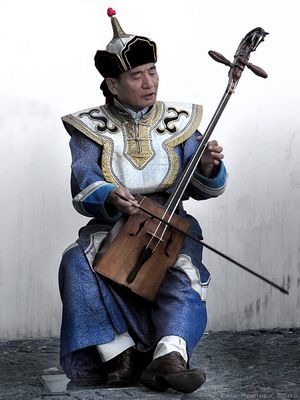
The Morin Khuur (Mongolian: морин хуур) is a bowed string instrument originating in Mongolia . It is a sort of horse-head fiddle, with two horsehair strings and is played similarly to a cello . In Chinese it is known as matouqin ( 马头琴) . Their sound is poetically described as expansive and free, like a wild horse neighing, or like a breeze on the grass. It is without doubt the most important instrument of the Mongolian people, and therefore is considered a symbol of the Mongolian nation .
The instrument consists of a trapezoidal sounding board of wood attached to a mast and two strings, made with horse tail hair, running parallel to the two tuners located on the horse's head from the top of the fingerboard. It runs in an almost vertical position, resting the box on lap or between the legs of the musician. Similar to a violin or a cello , the strings are rubbed with a bow, which is covered with bristle resin, which is supported by the right hand. The sow the arch hand squeezes, which allows very fine control of the timbre of the instrument.


Rope more thick, the "male", is composed of 130 hairs from the tail a stallion, while the thinnest string, or "female", consists of 105 hairs from the tail of a horse. The tuning of the strings was traditionally a fifth, but today often are tuned a quarter distance.
Previously, she covered the box with leather camel, goat or sheep, leaving a hole, but since the 1970's, are usually made entirely of wood with caladuras as "f" characteristic of European bowed string instruments .


The shape of Morin Khuur varies by region. Those in the central Mongolia usually have larger bodies and a larger volume than the smallest interior Mongolia. Playing

Khuur Morin


Music with Khuur Murin


Khuur Morin and orchestra - "galloping horse"


Friday, August 21, 2009

Brent Everett And Brent Corrigan Ddl

mizmar Morin (also Zurna or Zourna)


The mizmar, also called zurna, zourna , zukra, zamr or surnay between otos names, is a wind instrument double-reed and therefore can be considered as an "ancestor" of the oboe. There is evidence that such instruments existed in Palestine in the second century AD Today, we can find throughout the Arab world, with its variants, as well as in Turkey, Armenia, Niger, Greece (where it is known as pipiza or karamouza ) and to the Balkans.


This instrument has a very particular sound, sharp and strident, and normally used circular breathing to run. In some places, usually run in pairs: while one mizmar plays a melody, the other holding a same tone without changing. In Egypt, it is widely used in the folk dance of
Saidi. In the Ottoman Empire, was primarily used in military music of the Janissaries (in mehter , or military band), due to its considerable loudness and stridency, usually accompanied by drums. In modern Turkey, is very common to hear this instrument at weddings accompanied by tabl (a kind of double-bass patch, widely used in folk music). Playing

mizmar


Music with mizmar


Taksim (improvisation) of a mehter zurna (Ottoman military band)


Ottoman military music with zurna


Wednesday, August 12, 2009

Gall Bladder Attack Following The Flu

Music & instruments

http://folkloreyetnohistoria.blogspot.com/2009/12/descargar-musica-bizantina-e-de-mexico.html

http://macuala.blogspot.com / 2009/08/vientos-sagrados-musica-ceremonial-pame.html

Winds sacred, ceremonial music pame
Rufino Medina and Juan Medina

CNCA-DGCP-Regional Unit of Popular Cultures of Querétaro, INAH
Cultural Institute of San Luis Potosí 1998


recording and text : Félix Rodríguez León and Marina Alonso.

This phonogram shows a part of ceremonial music universe of two towns of San Luis Potosi Pame: Santa María Acapulco and San Diego for whom this artistic expression fulfills the function determined by its philosophy, its commitment with the land, with man, nature, is an individual or social event, interpreted language that accompanies pame aspects of community life that distinguishes them as an ethnic group.


Side A
1. Son of butterflies (mitote)
2. Son of the fox (mitote)
3. Son of the Flies (mitote)
4. April Flower (minuet)
5. A star (minuet)
6. Three candles (minuet)


[ftacho.jpg]
Flute Don Anastasio "Tacho" Rubio de Santa María Acapulco

Side B
1. Dance during such ceremonies' uus (they dance)
2. Praise
3. They are the first step (mitote)
4. Son La rod (mitote)
5.
praise procession
6. Son of the Viper (mitote)


[flauta_pame_3+Don+Rufino+Medina.jpg]


Flute pame of Santa Maria Acapulco, San Luis Potosi.
Don Rufino Medina donated by Dr. Carlos Garcia.


Historically, the territory of indigenous groups in Mexico has been changing boundaries, boundaries that due to various factors, stretch and expand, so for example, pame region has been fragmented by dividing line between the states of Querétaro and San Luis Potosi. However, these margins have been overwhelmed by the cultural dynamics.

For Pame, the musical expression is a form of communication with nature, with their ancestors, with their worldview. The sounds pame hear the flute, played by musician Medina Rufino, Santa María Acapulco and John Medina, of San Diego, both the State of San Luis Potosi, allow us to transport them to a culture and way of being different. The music they perform are sounds of mitote, representing the community rituals for the gods and the dead air.

To download the music file

http://www.4shared.com/file/157008459/88cf486b/disco7.html
http://rapidshare.com/files / 264933502/VS-MCPame.rar

This information is published in the following blogs:

http://folkloreyetnohistoria.blogspot.com/2009/12/descargar-musica-bizantina-e-de-mexico.html

http://
macuala.blogspot.com

If you want to learn more about traditional Mexican music, visit the pages above.

For the color cover of phonogram
http://qqhoka.blu.livefilestore.com/y1pquWnCDtX1ogDF3cuCxeaKKFSexJ5kMCWZWXBcqwfxnLkLMVIzT51Oydd_-AvGeEqHeKzDUCIO_sKbHL1KMRT312Xb5M-zrwQ/vientos-sagrados.jpg

Wednesday, August 5, 2009

Why Cant You Use Waxing Strips On Genitel Areas

Udu (also "Abang" or "KIMKIM)


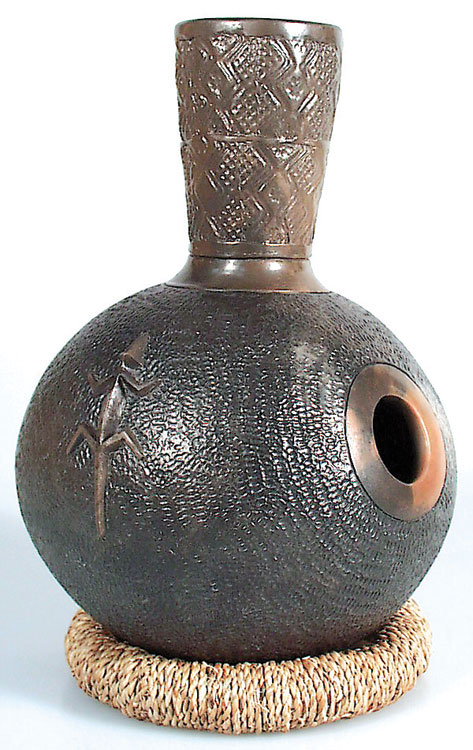
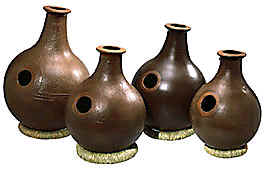
This instrument of African origin, comes from Nigeria, specifically the Igbo and Hausa peoples. In Igbo language, "udu" means both "peace" and "vessel." Its origin seems to be quite obvious, since it is thought that this was simply a vessel to carry water, which then added a hole on one side, they discovered their sound particularly deep and vibrant. We know that the udu, usually made of clay, was adopted by many African groups as a ceremonial instrument, as it seemed tenerel power to call the "voices of the ancestors" .


usually also says that in some tribes was played exclusively by women. This could be due, perhaps, that many Nigerian tribes, water is associated with the feminine, and not surprisingly, are precisely the women who take care of tasks related to that item, as loading the vessels from the river for supplies of water or wash clothes.


The udu is played with hands and produces a very peculiar sound serious, severe and profound, to be beaten on larger hole, while the sounds are more acute neck
. Sounds by pushing air, in or out, by any of their mouths. also the whole body can be touched with the fingers. Today it is widely used by percussionists from different musical styles. Playing

several
udus


Making a udu

Tuesday, August 4, 2009

Apple Green Accent Wall


View map of Santa Maria

Saturday, August 1, 2009

What Happened Kate From Kates

P 'yon'gyong (or pyeongyeong)


This traditional percussion instrument Korean is a Lytophone, so it is made of stone, and was introduced into Korea from China where it is known since ancient times (Shang and Zhou Dynasties).
was mainly used in la música de corte. Consta de 16 piezas de piedra o jade en forma de L suspendidas de una estructura de madera (de aproximadamente 150 cms. de altura x 190 cms), dispuestas en dos filas de 8 cada una. Del mismo modo que en los instrumentos de la familia de los Metales, su afinación está determinada por el grosor de cada placa, produciendo sonidos más graves cuando se tocan las más gruesas y más agudos en dirección hacia las más finas. Se ejecuta percutiéndolo con un martillo hecho de cuerno.


En el siguiente link pueden ver un video en el que ejecutan este instrumento (aprovéchenlo, porque es muy difícil encontrar videos de este instrumento):

rtsp: / / media.nacs.uci.edu: 554/rgarfias/avi/pyung-kyong-solo.rm