
The shakuhachi is a wind instrument, more precisely, a bamboo flute from Japan. This flute is held vertically so as a recorder. His name is directly related to its standard size: shaku, means "foot" as the unit of measurement and hachi eight, meaning that the instrument has a length of 1 shaku point 8 (equivalent to 54.5 cms .) However, although the name of this instrument refers to a specific size, there shakuhachi flute various measures.

This instrument is played by blowing through one end, in a way that is blown simirlar the edge of the spout of a bottle. Because at its other end terminates in a sharp edge, allows the performer substantial control over the tone. The shakuhachi provides a range of two full octaves (the most severe is called Otsu and sharper Kan) and an incomplete third octave ( Tai-Kan.) The different octaves are achieved through subtle changes in breathing and in the mouth, which it closely resembles the nay Arabic. The five holes of the flute is tuned in pentatonic mode without semitones, but the player can customize each pitch as much as a tone or more using techniques known as meri and kari , achieved by changing the blowing angle , which can get tones higher or lower, respectively.

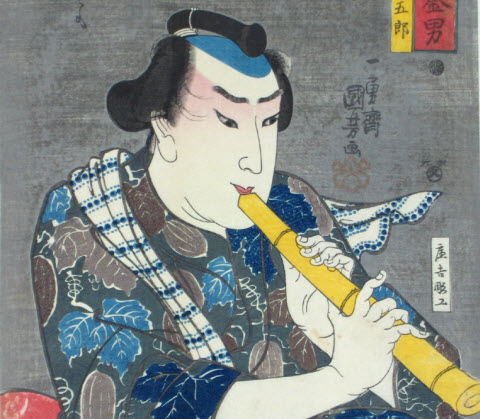
Japan has over six hundred varieties of bamboo and building a professional tool is used only one of these varieties. As can be seen in the photos, the bottom of the flute is a bit Masanche and sometimes curved, which is that used bamboo lower right where the roots begin to appear. The average diameter of the pipe is 4 to 5 cm. and has 4 holes in front and one in the front, which produce the following notes: re, fa, sol, la, C and D, although both techniques fingering complex as air pressure and change of position (angle) of the instrument chromatic scale can be achieved, what has become a very versatile instrument for contemporary music. La embocadura ha variado con el paso de los siglos pero en la actualidad se asemeja un poco a la de las quenas.
Historia
Historia
"La historia de la flauta Shakuhachi se remonta al periodo Nara (s. VIII) cuando fue introducida desde China y empleada en el conjunto de la música cortesana Gagaku. Este instrumento tenía 6 orificios, 5 al frente y uno en la parte anterior. Luego de una reforma a la música de la corte durante el período Heian, este tipo de flauta desapareció. Mucho más tarde, durante Muromachi (1338-1573), llega de China otra flauta vertical de menor tamaño llamada Xiao in Chinese and would give rise to Hitoyogiri measuring just a point 1 shaku (33.3 cm). This was originally used by monks beggars ( komos ) and later became popular as a means of entertainment but is said to his repertoire disappeared along with Komuso . This could occur due to your high-pitched sound, which is said, could not compete with the deep tones and expressive modern Shakuhachi .


Shakuhachi Flute used today is derived from the instrument appeared in the early period Edo (1603-1868) in the hands of itinerant monks ( Komuso -not to be confused with komos ) of the Fuke sect of Zen Buddhism These monks in their training had three main practices: meditation known as zazen The interpretation of the Shakuhachi flute and sometimes practice a martial art which was used in the heavy body of the flute as a weapon of defense because of the danger it posed to travel in parts of Japan at the time .
In interpreting these monks sought flute basically two things: the issue of harsh sounds, or "dirty" -Because they believed that through these could purify his spirit, and breath control.


During the Edo period appeared several styles of interpretation of the Shakuhachi Flute: Myoan (Meian) in Kyoto, and Kinko in Tokyo at the headquarters of the Komuso , and during the Meiji period (1868-1912), a new school called Tozan dedicated to teaching the flute to students of all backgrounds. Initially conceived as a solo instrument among the monks, by the eighteenth century began to be used in music entertainment, a kind of chamber music, beside the Koto harp and lute shamisen.
The repertoire of this instrument consists of honkyoku or original parts or parts Gaikyoku "borrowed" (lit. foreign melodies) and Shinkyoku or new compositions. "


Excerpt from: www.japonartesescenicas.org
Shakahuchi touched by Tadashi Tajima
David Sasloff improvising with Shakahuchi
Music Japanese traditional Shakahuchi, Koto and Shamisen
Dialogues between a Turkish and a clarinet Shakahuchi
piano duo and Shakahuchi
Jazz Shakuhachi
David Sasloff improvising with Shakahuchi
Music Japanese traditional Shakahuchi, Koto and Shamisen
Keiko Matsui - Light Above the Trees
Dialogues between a Turkish and a clarinet Shakahuchi
piano duo and Shakahuchi
Jazz Shakuhachi


0 comments:
Post a Comment